 |
Diana D. LaurentAbout the London
Bombings
|
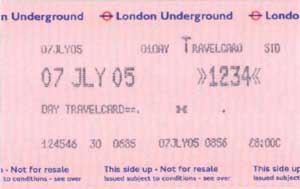
July 7, 2005 was to be the only day I had in London to do some shopping and sightseeing. I have been to the city (my favorite in the world) twice before, so I didn't feel compelled to take in a lot of sights. I did, however, want to see the special Chihuly glass exhibit in the Royal Botanical Gardens at Kew, about 11 miles south of where I was in the City. I had an appointment near Regent's Park at noon, so I got up early and headed out the door to the nearest Underground station shortly after 8:30 AM. I figured I'd have about an hour and a half to take in the flowers and glass art before returning. After my noon appointment, I was to meet a friend and colleague for a matinee of "Billy Elliot" at the Victoria Palace and dinner afterwards. Somewhere I hoped to do a little shopping, as well.
The third stop on my journey was Edgware station. When we stopped at Edgware, everything seemed normal. People got off and on the train, and the platform was as one would expect. Apparently, the bomb went off within seconds after my train pulled out of the station. People were hurt. People died. Thank God I didn't see any of it.
I felt uneasy during the couple of minutes to the next stop, and wasn't sure why. I thought I heard something, but told myself that it was just an abnormality in the track or something. Maybe I heard the bomb and maybe I didn't. The Tube is not a quiet environment.
Just as we were about to arrive at Paddington station, there was an announcement on the public address system on the carriage. There was a massive "power surge" and the entire underground was shut down, it said, and we were to leave the station and find alternate transportation. I didn't believe that there was a power surge. As I got off the train, I sniffed the air. I thought I smelled smoke, but it didn't smell electrical. At that point I felt strongly that it was a bomb.
Thankfully, Paddington's Tube station is close to the surface, so I didn't have to climb as many steps as others must have at other stations. When I reached the street, there were sirens everywhere, and many ambulances racing back the way we had come. I overheard 2 police officers talking about 2 bombs in tube stations, one at Edgware. I was a little startled to learn how close I had come. People were streaming out of the Tube station and trying to board the few busses waiting outside. For some reason, I decided to leave the area on foot, hoping to find a taxi at Hyde Park. That turned out to be totally unrealistic. I don't know where people were getting the taxis, but there wasn't a taxi in the city that wasn't already engaged. By then the bus bomb had also shut down the bus system. The entire city was on foot.
My first thought was to let my family know that I was OK. I knew there would be panic at home if they heard about the bombings before they heard from me, so I immediately used my cell phone to call home. I knew Michael would still be up at 1:30 AM. Many people on the street had phones to their ears, but none of us were able to get through. The system was overloaded, and the mobile providers had turned over much of their bandwidth to emergency services. I knew I had to get back to my lodgings and to email before the Internet also jammed up, so I set off on foot down Oxford Street. Those of you who know me well know that walking has been a problem for me. Things have been much better in the last year, so I was able to make it back to where I was staying on foot. It took me an hour and a half and was painful at times, but I was able to do it. I emailed immediately upon returning. The porter and some of the other guests I had breakfast with seemed relieved to see me.
London looks and feels different without busses and a lot of taxis and cars on the streets...and there were people everywhere on foot. It was raining on and off, and the day was gray. With the exception of the sirens, it was eerily still. As I walked on Oxford Street, people weren't talking. There was no panic. There was no crying. People were walking with quiet determination. Meanwhile, the emergency plan worked flawlessly. The British were ready for this. Teams of 4 trauma specialists were brought to each bombing site by helicopter within minutes. Double-decker busses were used for triage and hospital transport for the non-critically injured. There were officers at every Underground station entrance within minutes. The Tube and busses were running again the next day.
Your mind starts playing "what if" games in situations like this. What if I had spent a little more time talking to my breakfast companions and arrived at Edgware a few minutes later? What if there was a queue at the ticket machine at the station? What if I had left earlier and made it to Kew and been stranded with no way to get back to central London? The fact is that even if I had been at the station when the bomb blew, it would not have been my train. The worst that could have happened to me physically is cuts and bruises and smoke inhalation. Ultimately, the very worst that could have happened to me is being an eyewitness to the horror and having to live with those images for the rest of my life. I was spared that and I am exceedingly thankful.
My British friends have asked me if this will keep me away from England and London. No way. I will probably be a little apprehensive on the Underground, but I will ride the Tube again. I will not allow extremists to dictate how I live my life.